
CITB Specialist Demolition Test
The CITB Specialist Demolition test (DEM) is the HS&E paper for demolition work: 50 questions in 45 minutes, core questions plus demolition questions, and 45 correct answers to pass.
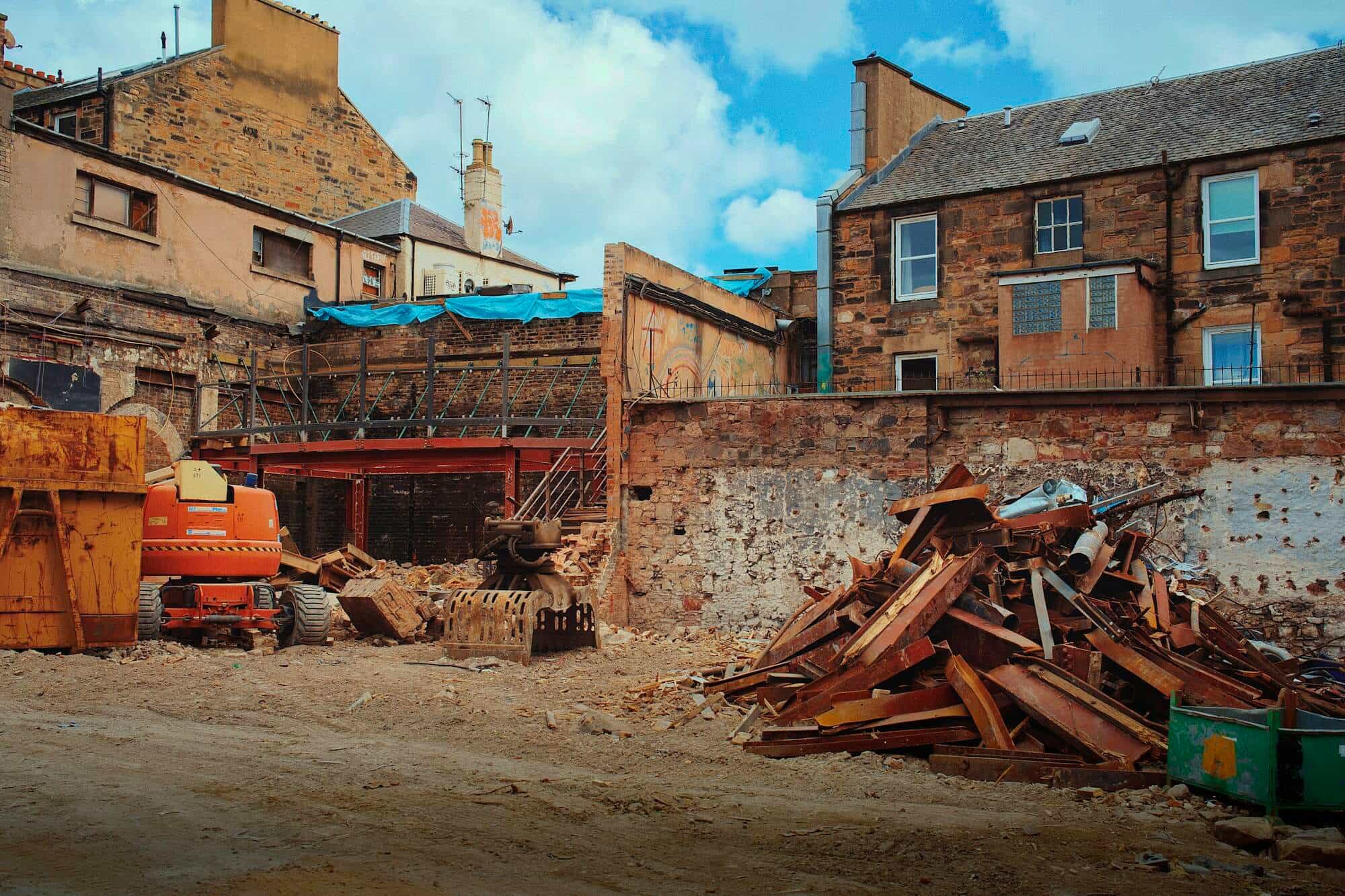
DEM is one of the CITB Specialist Tests. Our demolition questions follow the order the work happens in: survey the structure, plan the method in writing, give notice, then take the structure down without an uncontrolled collapse. They are built mainly on HSE's demolition guidance and its guidance on structural stability during demolition. Start the free DEM mock below and read the worked explanation after each answer. The test has voiceover in English or Welsh only (CITB, checked 31 October 2026). We do not book tests.
Start the Demolition mock test
Start a 50-question, 45-minute Demolition mock that mixes core questions with demolition questions, and see every answer explained. Our mock gives you 20 demolition questions and 30 core questions. That split is our design: the CITB pages we checked do not say how the CITB test divides its 50 questions. The mock is free: 3 mocks every 7 days without an account. A paid plan gives you unlimited mocks.
Free timed mock
CITB Specialist Demolition Mock Test (timed)
- questions
- 50
- questions
- minutes
- 45
- minutes
- to pass (90%)
- 45
- to pass (90%)
Ready when you are
Find a quiet 45 minutes. The clock starts when you press start, and you see your score the moment you submit.
- Timed, exam conditions like the real CITB HS&E test. This mock shows you the answers at the end.
- A fresh set of questions every attempt: 20 on Demolition and 30 across CITB's five core knowledge areas.
- The clock keeps running if you leave the page, as it would in the test centre.
- Every answer comes with a worked explanation.
Who sits the Demolition test?
The Demolition test is the CITB HS&E Specialist paper for demolition work; check the card finder CITB links to before you book. CITB's Specialist test page does not list the jobs that need each specialism. It points you to a card finder to check which HS&E test you need. If your main work is another trade, check whether one of the other 11 specialisms fits.
What do Demolition questions cover?
Our demolition questions cover the method and sequence of work, exclusion zones, structural stability and temporary support, asbestos before demolition, and the notice a local authority needs.
| Law or guidance | What the questions ask |
|---|---|
| HSE guidance on demolition | Choosing a method and a sequence that avoids an uncontrolled collapse, and how exclusion zones change with the method |
| HSE guidance on structural stability during alteration, demolition and dismantling | Why a standard scaffold will not restrain a building, and who must design facade retention |
| HSE CIS45, Establishing exclusion zones when using explosives in demolition | The four areas an explosives exclusion zone is built from |
| The Building Act 1984, sections 80 and 81 | Giving the local authority notice of a demolition, and who must get a copy of the notice |
| The Construction (Design and Management) Regulations 2015 | Temporary supports that must withstand any foreseeable loads (regulation 19), and demolition arrangements recorded in writing before the work begins (regulation 20) |
The table lists the sources our practice questions cite most.
How the questions are usually put
- Planning questions ask what CDM 2015 or HSE guidance needs before and during the work, such as temporary supports or the order elements come out.
- Exclusion zone questions ask how a zone is built, or how its size changes with the method.
- Notice questions ask who must be told about a demolition under the Building Act 1984.
The rest of the paper is core questions, so practise Respiratory Hazards Questions and Working at Height Questions too.
Demolition sample questions with worked explanations
Here are 10 demolition practice questions, each with the answer and a worked explanation.
Sample question 1 · Demolition
What does CDM 2015 regulation 21(1) say about explosives brought onto a demolition site?
- They must be kept in the site office under the manager's key
- They must be logged with the police force for the local area
- They must be stored, transported and used safely and securelyCorrect answer
- They must be delivered on the day of the blast and never held
Why C: Regulation 21(1) of CDM 2015 requires that, so far as is reasonably practicable, explosives are stored, transported and used safely and securely. Security matters as much as safety, because explosives taken from a site are a danger to the public as well as to the workforce.
Sample question 2 · Demolition
What sequence of work does HSE give as an example of one that avoids an uncontrolled collapse?
- Take out the elevations in turn, starting with the longest one
- Take out non critical elements first, working towards stiff coresCorrect answer
- Take out the ground floor first so the building settles evenly
- Take out the stiff braced cores first to release the structure
Why B: HSE guidance on demolition says a sequence should be adopted that eliminates the possibility of an uncontrolled collapse, giving the example of removing elements that are not critical to overall stability first, then working towards stiff elements such as braced cores.
Sample question 3 · Demolition
What does a refurbishment and demolition asbestos survey involve on site?
- A desk study of the original construction drawings on their own
- Destructive inspection, with the area vacated during the surveyCorrect answer
- A visual walk round, with the building still fully occupied
- Air sampling only, taken from outside the shell of the building
Why B: HSE says a refurbishment or demolition survey must locate and identify asbestos containing materials, including those hidden within the building fabric, before structural work begins. It involves destructive inspection and potential disturbance, so the area must be vacated and then confirmed fit for reoccupation.
Sample question 4 · Demolition
The supplies to a building due for demolition have been disconnected. What does HSG47 still warn about?
- Services crossing the site that are not part of its own suppliesCorrect answer
- Meters that have not yet been collected by the utility company
- Water left in the drainage runs that may need pumping out first
- The smell of gas that can linger in cellars for several days
Why A: HSG47 paragraph 175 warns that even where supplies have been disconnected you should beware of services that run through sites and are not part of the site supplies, and of pot ended or bottle ended cables. If in doubt, treat services as live.
Sample question 5 · Demolition
HSE advises a demolition client to contact the local authority early, before the formal notice is due. What does it say that early contact allows time to discuss?
- To get the local authority to choose which contractor should be used on the job
- To transfer the client's legal duties under CDM to the local council
- To book a council inspector to stand on site during the demolition
- To discuss working hours, traffic, scaffold licences and road closuresCorrect answer
Why D: HSE says early contact gives time to discuss working time restrictions, traffic movements, scaffold licences and potential road closures. Formal notice must still be given at least 6 weeks before work starts.
Sample question 6 · Demolition
Which of these does HSE list as part of a safe system of work for demolition?
- Letting the public watch from the edge of the debris zone
- Removing barriers so that plant can move around freely
- Working from the top of walls so the operative can see
- Reinforcing machine cabs so that drivers are not injuredCorrect answer
Why D: HSE lists exclusion zones with barriers, covered walkways, high-reach machines, reinforcing machine cabs so drivers are not injured, and training and supervising workers as parts of a safe system of work.
Sample question 7 · Demolition
What does CN4 say about the height that demolition material is dropped from during crushing and screening?
- It makes no difference to dust
- The first load matters most
- Keep it as low as possibleCorrect answer
- Drop it from the highest point
Why C: CN4 lists minimising the height material is dropped from as one of its equipment and procedure controls. Crushing and screening creates high levels of dust, which may contain respirable crystalline silica.
Sample question 8 · Demolition
Does a refurbishment and demolition survey normally assess the condition of the asbestos it finds?
- Yes, but only for asbestos found in the outside walls of a building
- No, because only the amount of asbestos is recorded, not where it is
- No, apart from noting damage, as the asbestos is found so it can be removedCorrect answer
- Yes, the materials are scored for their condition, as in a management survey
Why C: HSG264 says that in this type of survey, where asbestos is identified so it can be removed rather than managed, the condition is not normally assessed, other than to note damage or debris. It must be assessed if removal will be delayed.
Sample question 9 · Demolition
A building is so dangerous that immediate action is needed. What can the local authority do under section 78 of the Building Act 1984?
- Only call HSE, which is the body that deals with all dangerous buildings
- Take the steps needed itself, giving notice to the owner and occupier if practicableCorrect answer
- Nothing until a court order has been made, however long that may take to arrange
- Only write to the owner, asking them to deal with the danger within the next 28 days
Why B: Section 78 lets the local authority take the steps necessary to remove an immediate danger, giving notice to the owner and occupier first if reasonably practicable, and recover its expenses.
Sample question 10 · Demolition
Lead-burning on a demolition job will only last a short time and some of it is in the open air. What does HSE's ACOP L132 say about the risk?
- It can still cause a very high concentration of lead fume before it dispersesCorrect answer
- Short jobs in the open air are too brief to give any exposure to lead at all
- Open air work with lead is exempt from the Control of Lead at Work Regulations
- The fume from lead-burning is only harmful when the work is done indoors
Why A: L132 paragraph 75 says brief work in the open air can still result in exposure to a very high concentration of lead dust or fume before it disperses, giving lead-burning during demolition as an example.
What has to happen before demolition starts?
Before demolition starts, the structure has to be surveyed, including for asbestos, the work has to be planned in writing, and the local authority may need to be told.
- Survey the structure, including a refurbishment and demolition survey for asbestos. HSE's survey guide, HSG264 (second edition, 2012), says this survey is needed before any refurbishment or demolition work. Where there is asbestos, the plan of work must say it comes out before any other major works begin, so far as is reasonably practicable (Control of Asbestos Regulations 2012, regulation 7).
- Record the demolition arrangements in writing before the work begins (CDM 2015, regulation 20).
- Give the local authority notice where section 80 of the Building Act 1984 applies, and send a copy to the occupier of any adjacent building and to the gas and electricity suppliers. Section 80 extends to England and Wales.
- Set out the safe working zones, exclusion zones and debris zones in the demolition method, and plan for them to change as the work goes on (HSE demolition guidance).
Demolition test FAQs
Which languages is the Demolition test in?
English or Welsh voiceover only, like every Specialist test (CITB). The questions and answers on screen stay in English.
Does the Demolition test cost more?
No. Every CITB HS&E test costs £23.50 (CITB, checked 31 October 2026).
Which CITB book covers the Demolition test?
CITB's revision page lists the GT100 book for Specialist tests: sections A to E, plus the relevant chapter in section F. CITB also lists a GT100 DVD and a GT100 download for Windows.