
Respiratory Hazards Questions
CITB respiratory hazards questions test whether you know how dust and fumes are controlled, and the right answer usually controls the dust at source before relying on a mask.
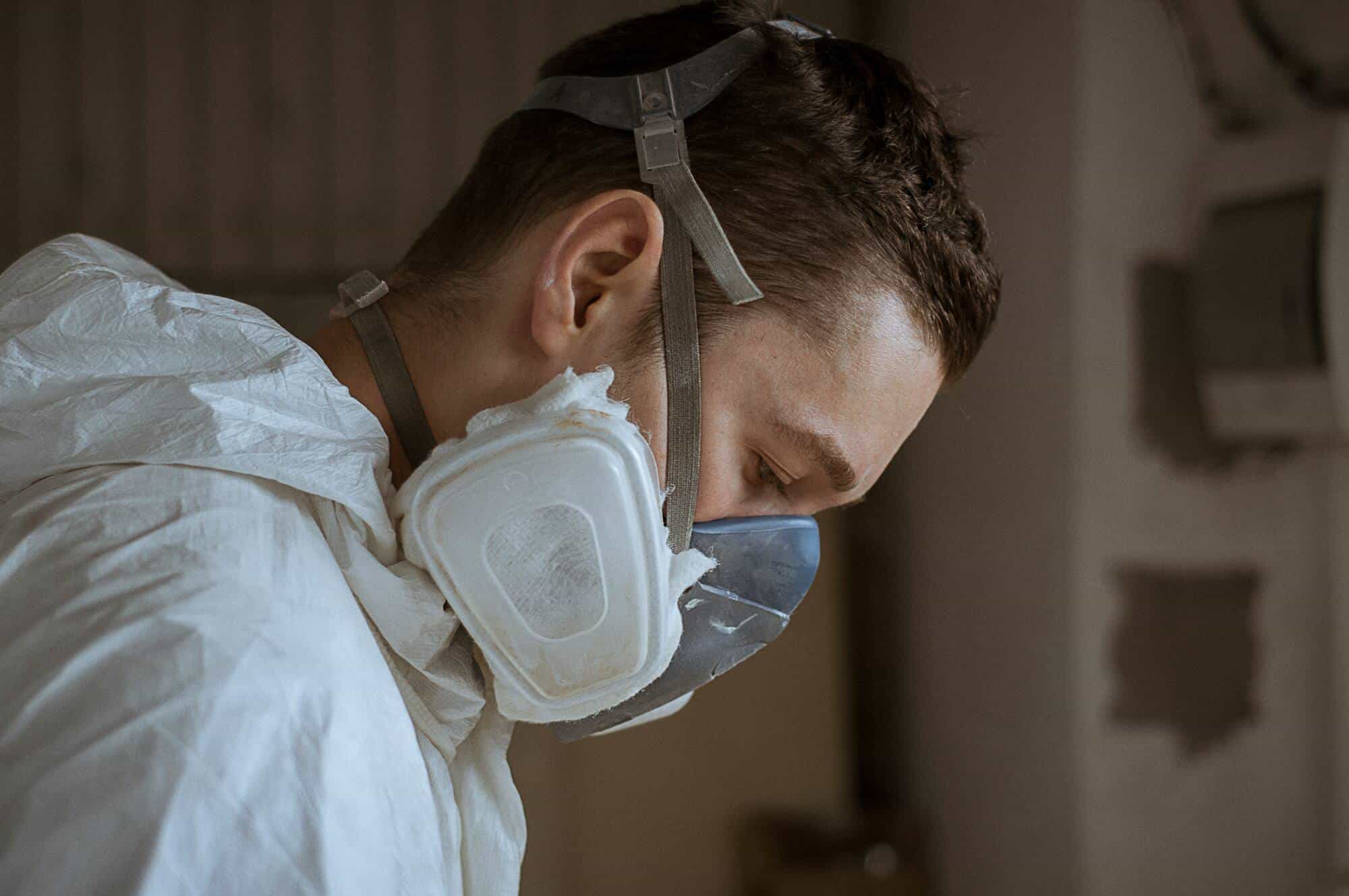
Many questions name a dusty task, such as cutting kerbs with a cut-off saw or chasing a wall, and ask which control comes first or where water and extraction fit. Others ask why a tight-fitting mask needs a face fit test. Our questions are built on the Control of Substances Hazardous to Health Regulations 2002, known as COSHH, and on HSE guidance, including its construction dust sheet CIS36. A common trap: a mask feels like the safe choice, but HSE calls RPE the last line of protection. Take the timed quiz below, then read the 10 sample questions further down, each with a worked explanation. Practise respiratory hazards before your CITB test for operatives or a Specialist test.
Start the respiratory hazards quiz
The timed respiratory hazards quiz draws from our full respiratory hazards set and explains every answer. The quiz is free: 1 quiz every 7 days without an account, or 30 a day with a free account. A paid plan gives you unlimited quizzes.
Free practice quiz
Respiratory Hazards practice quiz (timed)
- questions
- 20
- questions
- minutes
- 30
- minutes
- to pass (90%)
- 18
- to pass (90%)
Ready when you are
Find a quiet 30 minutes. The clock starts when you press start, and you see your score the moment you submit.
- Answers and explanations are shown at the end, with every question to review.
- A fresh set of questions every attempt, drawn from our Respiratory Hazards set.
- About 90 seconds a question, against about 54 in the real test, so there is time to think.
- Every answer comes with a worked explanation.
How do CITB respiratory hazards questions usually ask it?
Respiratory hazards questions usually describe a dusty job, a mask or a material, then ask which control comes first, why a mask must fit, or which dust does the harm.
| Question pattern | What it looks like, in our words | What the right answer usually does |
|---|---|---|
| Order of controls for a dusty task | Cutting, chasing or drilling is described, and you put the controls in order or say where water suppression or extraction sits | Stops or reduces the dust first, then controls it at source with water or on-tool extraction, and adds RPE on top. COSHH puts protective equipment last, in addition to the other measures |
| Fit and use of a mask | A worker has a beard, a mask that leaks, or a mask that has never been fit tested | Picks the answer about the seal. HSE says RPE cannot protect the wearer if it leaks, tight-fitting masks need face fit testing, and stubble or a beard makes a good seal impossible |
| Which dust and what harm | You are asked which material holds the most silica, or which diseases dust can cause | Names the dust correctly. HSE gives sandstone as more than 70% silica, and says breathing construction dust can cause lung cancer, silicosis, COPD and asthma |
Which law and guidance are respiratory hazards questions based on?
Our respiratory hazards questions are built mainly on the Control of Substances Hazardous to Health Regulations 2002, with HSE guidance for construction dust, wood dust and choosing and fit testing RPE.
| Law or guidance | What the questions take from it |
|---|---|
| Control of Substances Hazardous to Health Regulations 2002 | Preventing exposure or, where that is not reasonably practicable, controlling it in order of priority (regulation 7), employers and workers making proper use of the controls (regulation 8), examining non-disposable RPE and testing extraction (regulation 9), and training (regulation 12) |
| HSE CIS36, Construction dust (revision 3, 2020) | The three main types of construction dust, water suppression and on-tool extraction, RPE with an assigned protection factor of 20, and face fit testing for tight-fitting masks |
| HSE HSG53, Respiratory protective equipment at work (fourth edition, 2013) | Why RPE is used, what the law says, and how to choose RPE that is adequate and suitable |
| HSE INDG479, Guidance on RPE fit testing, and HSE's fit testing basics page | Why tight-fitting facepieces are fit tested, when to do it and who should do it, and why facial hair breaks the seal |
| HSE, Wood dust | Hardwood dust causing cancer, particularly of the nose, wood dust causing asthma, and cleaning up with a suitable vacuum instead of sweeping |
Cement and other hazardous products need a COSHH assessment of their own, and COSHH Questions covers assessments, safety data sheets and the order of controls.
Respiratory hazards sample questions with worked explanations
Here are 10 respiratory hazards practice questions, each with the answer and a worked explanation.
Sample question 1 · Dust, Fumes & Respiratory Risks
What duty does regulation 8 place on the employee?
- To buy replacement filters for the respirator they have been issued
- To monitor their personal exposure and record it at the shift end
- To carry out their own assessment of the dust risk before starting
- To make full and proper use of the control measures providedCorrect answer
Why D: Regulation 8(2) requires full and proper use, returning the item to any accommodation provided for it, and reporting any defect forthwith.
Sample question 2 · Dust, Fumes & Respiratory Risks
When is health surveillance appropriate for a worker exposed to dust?
- Whenever any dust at all may be present anywhere on the construction site
- Only after the worker has already developed breathing symptoms
- Where an identifiable disease may be linked and is reasonably likelyCorrect answer
- Only where the employer chooses to provide it as a staff benefit
Why C: Regulation 11(2) sets the test: a Schedule 6 substance and process combination, or an identifiable disease or adverse health effect reasonably likely under the conditions of the work.
Sample question 3 · Dust, Fumes & Respiratory Risks
Schedule 4 of COSHH is relevant to which duty?
- The frequency of thorough examination for certain LEV plantCorrect answer
- The list of the substances that require health surveillance
- The information that must be given to exposed employees
- The circumstances in which PPE may be used on its own
Why A: Regulation 9(2)(a) refers to Schedule 4, which sets shorter maximum intervals than 14 months for LEV used with certain specified processes.
Sample question 4 · Dust, Fumes & Respiratory Risks
An employer provides extraction but nobody is trained to use it. Which duty is breached?
- Only the duty to examine the equipment every fourteen months
- The duty to provide information, instruction and trainingCorrect answer
- Only the duty to monitor exposure at regular intervals
- No duty, because providing the equipment is what matters
Why B: Regulation 12(1) requires suitable and sufficient information, instruction and training, and principle (g) requires training on the use of the control measures developed.
Sample question 5 · Dust, Fumes & Respiratory Risks
Does HSE count dust from cutting MDF and plywood as wood dust?
- No, MDF and plywood dust count as 'general' dust instead
- No, they are classed as silica dust because of the glue used
- Yes, but dust from plywood counts, while dust from MDF does not
- Yes, wood dust includes dust from wood-based products like MDFCorrect answer
Why D: CIS36 defines wood dust as dust created when working on softwood, hardwood and wood-based products like MDF and plywood.
Sample question 6 · Dust, Fumes & Respiratory Risks
A worker's overalls are covered in silica dust at the end of a cutting job. What does HSE say NOT to do?
- Wet clean the dust from the work area afterwards
- Change out of the overalls before going on a break
- Report the dusty conditions to the supervisor
- Use compressed air to blow the dust off the clothingCorrect answer
Why D: INDG463 tells workers not to dry sweep and not to use compressed air for removing dust from clothing. For cleaning up it says to use a vacuum of dust class M or H, or wet cleaning.
Sample question 7 · Dust, Fumes & Respiratory Risks
A respirator carries a CE mark. What does HSE say that tells you about whether it suits your task?
- It means the RPE never needs to be fit tested to the wearer
- It means the RPE can be used in oxygen-deficient atmospheres
- It does not make the RPE automatically suitable for the taskCorrect answer
- It proves the RPE has been tested for the tasks on site
Why C: HSE explains that the CE mark confirms RPE meets minimum design requirements but does not make it automatically suitable for a task. Employers must select RPE for the task, substance, environment and wearer.
Sample question 8 · Dust, Fumes & Respiratory Risks
A worker carries out a pre-use seal check every time they put on their fit-tested mask. Does that replace the fit test?
- Yes, once the worker has done the seal check for a full year
- Yes, as long as a supervisor watches the worker do the seal check
- No, a pre-use seal check is not a substitute for fit testingCorrect answer
- Yes, if the seal check is done at the start of the working day
Why C: INDG479 says a pre-use wearer-seal check should be carried out each time a fit-tested facepiece is worn, but it is not a substitute for fit testing.
Sample question 9 · Dust, Fumes & Respiratory Risks
Which habit does HSE say makes a person exposed to asbestos at much greater risk of lung cancer?
- Wearing contact lenses
- SmokingCorrect answer
- Drinking coffee
- Working nights
Why B: HSE states that you are at a much greater risk of developing lung cancer from asbestos if you smoke.
Sample question 10 · Dust, Fumes & Respiratory Risks
What does HSE say repeated exposure to diesel engine exhaust over many years can do?
- Increase the risk of lung cancerCorrect answer
- Cause hearing loss in both ears
- Cause white finger in the hands
- Improve tolerance to the fumes
Why A: HSE states there is evidence that repeated exposure to diesel engine exhaust emissions over many years can increase the risk of lung cancer, as well as causing short-term irritation.
Which respiratory hazards answers catch people out?
The traps are answers that reach for the mask first, trust a mask that does not seal, and judge the risk by how much dust you can see.
A mask comes after the other controls. COSHH requires exposure to be prevented, and where that is not reasonably practicable it must be controlled, with protective equipment last and only in addition to the other measures. HSE's CIS36 calls RPE the last line of protection and says that if you rely on RPE alone you need to be able to justify why.
A tight-fitting mask only works if it seals. HSE says RPE cannot protect the wearer if it leaks, and that poor fit is a major cause of leaks. Face fit testing checks that the mask suits the wearer, and stubble or a beard makes a good seal impossible. A worker with a beard for a good reason, such as religion, can use RPE that does not rely on a tight fit.
The amount of silica depends on the material. HSE's table gives sandstone, gritstone and quartzite as more than 70% silica, concrete and mortar as 25% to 70%, brick and granite as up to 30%, and limestone, chalk and marble as up to 2%. HSE also says the finest silica dust is too fine to see in normal lighting, so a cut that looks clean can still put it into the air.
Where does respiratory hazards sit in the CITB test?
Respiratory hazards are part of the core knowledge you practise for the CITB Operatives test. The Specialist tests include the core questions too, so the same knowledge counts there.
Respiratory hazards FAQs
Why does a dust mask need a face fit test?
A tight-fitting mask only protects you if it seals against your face, and HSE says poor fit is a major cause of leaks. A fit test checks that the make, model and size suit you, and you need to be clean-shaven for the seal to work.
Are these the real CITB test questions?
No. These are practice questions written for this site, each tied to the law or HSE guidance it tests; CITB does not publish its test questions.