
Environmental Awareness Questions
CITB environmental awareness questions test whether you know your duties for waste, pollution and protected species, and the right answer usually keeps the waste paperwork and stops pollution at source.
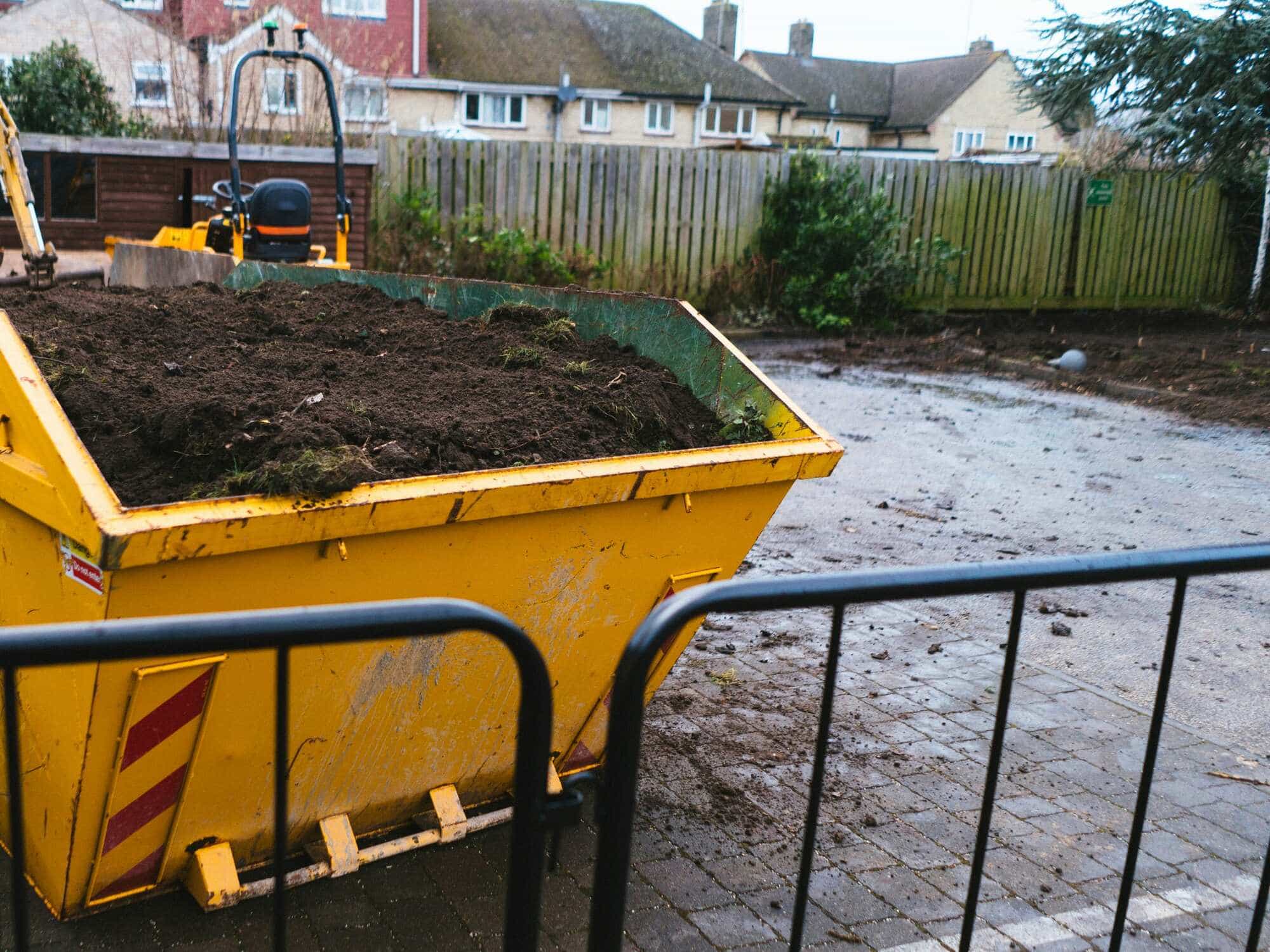
Most questions put you beside a skip, a fuel delivery or a drain, and ask who owns the waste, what paperwork goes with it, or what can go down which drain. Our questions are built on the waste duty of care in section 34 of the Environmental Protection Act 1990, the Waste (England and Wales) Regulations 2011, and Environment Agency guidance on pollution and oil storage. A common trap: thinking the client or householder is responsible for the waste a trade produces. The government's duty of care code says the tradesperson is. Take the timed quiz below, then read the 10 sample questions further down, each with a worked explanation. Practise environmental awareness before your CITB test for operatives or Specialist test.
Start the environmental awareness quiz
The timed environmental awareness quiz draws from our full environmental awareness set and explains every answer. The quiz is free: 1 quiz every 7 days without an account, or 30 a day with a free account. A paid plan gives you unlimited quizzes.
Free practice quiz
Environmental Awareness practice quiz (timed)
- questions
- 20
- questions
- minutes
- 30
- minutes
- to pass (90%)
- 18
- to pass (90%)
Ready when you are
Find a quiet 30 minutes. The clock starts when you press start, and you see your score the moment you submit.
- Answers and explanations are shown at the end, with every question to review.
- A fresh set of questions every attempt, drawn from our Environmental Awareness set.
- About 90 seconds a question, against about 54 in the real test, so there is time to think.
- Every answer comes with a worked explanation.
How do CITB environmental awareness questions usually ask it?
Environmental awareness questions usually put you beside a skip, a drain or a fuel store, then ask who is responsible, what paperwork the waste needs or where a liquid can go.
| Question pattern | What it looks like, in our words | What the right answer usually does |
|---|---|---|
| Waste paperwork | A skip or lorry load leaves site, or an officer asks to see your records, and you choose what goes with the waste and how long it is kept | Sends a signed written description with every transfer and keeps it. The 2011 Regulations say both sides keep it for at least 2 years and produce it within 7 days when an officer asks |
| Who owns the waste | A trade produces waste in a client's building or a householder's home, and you pick who is responsible for it | Names the trade that produced it. That trade must then pass the waste only to an authorised person, such as a registered waste carrier |
| Drains and spills | Washout water, fuel or a spill is near a drain, and you choose where it can go or what to do first | Keeps it out of the surface water drain. Environment Agency guidance says surface water drains discharge directly to the environment, so only clean water may go into them |
Which law and guidance are environmental awareness questions based on?
Our environmental awareness questions are built mainly on the waste duty of care in the Environmental Protection Act 1990 and its code of practice, with Environment Agency guidance for pollution prevention and oil storage.
| Law or guidance | What the questions take from it |
|---|---|
| Environmental Protection Act 1990, section 34 | The waste duty of care: stop waste escaping from your control, transfer it only to an authorised person, and pass on a written description of it |
| Waste duty of care: code of practice (Defra and the Environment Agency, updated 2018) | Who counts as a waste producer, including builders and plumbers, checking that a carrier is authorised before you hand over waste, and keeping the paperwork: 2 years for non-hazardous waste, three years for hazardous waste consignment notes |
| Waste (England and Wales) Regulations 2011 | The waste hierarchy as a priority order: prevention, preparing for re-use, recycling, other recovery, then disposal (regulation 12), and what a waste transfer note must contain (regulation 35) |
| Environment Agency and Defra, Pollution prevention for businesses | Only clean water in surface water drains, blue manhole covers for surface water and red for foul water, and a spill kit near storage, loading areas and transfer routes |
| Control of Pollution (Oil Storage) (England) Regulations 2001, with Environment Agency guidance on storing oil | Oil containers standing in a bund or other secondary containment that holds at least 110% of the container, and a drip tray when the fill pipe is outside the bund |
| Wildlife and Countryside Act 1981, section 14 | The offence of planting or otherwise causing to grow in the wild any plant listed in Part II of Schedule 9, which includes Japanese knotweed |
These are the rules in England and Wales, and the oil storage regulations apply in England. Scotland has its own version of the duty of care. Waste and spills are about protecting the environment. The rules that protect the people who handle hazardous substances are covered in COSHH Questions.
Environmental awareness sample questions with worked explanations
Here are 10 environmental awareness practice questions, each with the answer and a worked explanation.
Sample question 1 · Environmental Awareness & Waste
Besides transferring the waste itself, what does section 34(1)(c)(ii) require to be handed over?
- A written description letting others avoid an offence and stop escapesCorrect answer
- A photograph of the fully loaded skip taken just before it leaves the site
- A signed copy of the site waste management plan for the whole job
- A weighbridge ticket showing both the gross and the tare weight
Why A: Section 34(1)(c)(ii) requires a written description of the waste good enough to let the people receiving it avoid breaching section 33 or the permitting rules and to comply with the duty about escape of waste. Photographs and weighbridge tickets do not describe the nature of the waste.
Sample question 2 · Environmental Awareness & Waste
How long must a hazardous waste producer preserve the record of the waste after transferring it on?
- Only until the consignee quarterly return has been received
- For twelve months after the waste is transferred to another person
- For three years after the waste is transferred to another personCorrect answer
- For six weeks after the waste is transferred to another person
Why C: Regulation 49(3) requires the record to be preserved while the person holds or controls the waste and for three years after it is transferred to another person. That is longer than the two year period that applies to ordinary waste transfer notes.
Sample question 3 · Environmental Awareness & Waste
What may a local authority specify in a notice served under section 60 of the Control of Pollution Act 1974?
- The insurance cover the principal contractor is required to hold
- The hours during which the works in question may be carried outCorrect answer
- The wages that must be paid to the operatives working on the site
- The parking arrangements for site vehicles on the nearby streets
Why B: Section 60(3) lets the notice specify the plant or machinery to be used or avoided, the hours during which works may be carried out, permitted noise levels at specified points and times, and provision for changes of circumstance. Wages and parking are outside its scope.
Sample question 4 · Environmental Awareness & Waste
Environment Agency guidance says a site storing materials, products or waste should create which plan to minimise pollution from a leak, spill or fire?
- A pollution incident response planCorrect answer
- A construction phase health and safety plan
- A traffic management plan for all deliveries
- A site induction plan for the new starters
Why A: The Environment Agency says that whatever type of storage you have, you should create a pollution incident response plan to minimise pollution if there is a leak, spill or fire.
Sample question 5 · Environmental Awareness & Waste
How does the waste duty of care code define waste?
- Material that is sent to a landfill site for final disposal by burying
- Anything the holder discards, intends to discard or is required to discardCorrect answer
- Material that has no resale value at the moment it leaves the site
- Any material that is classed as hazardous under the classification rules
Why B: The code defines waste as any substance or object that the holder discards, intends to discard or is required to discard. Whether something is waste is decided case by case.
Sample question 6 · Environmental Awareness & Waste
From what container capacity do the oil storage rules apply at a business in England?
- Any size, even 5 litres
- 201 litres or moreCorrect answer
- 1,000 litres or more
- 3,501 litres or more
Why B: GOV.UK says businesses must follow the oil storage rules for a container of 201 litres or more. The 3,501 litre threshold applies to oil stored at a home.
Sample question 7 · Environmental Awareness & Waste
How far from watercourses, open drains and gullies does the Environment Agency advise placing storage of anything that could pollute?
- At least 50 metres
- At least 500 metres
- At least 10 metresCorrect answer
- At least 1 metre
Why C: The Environment Agency advises placing storage at least 10 metres from watercourses, open drains, gullies, unsurfaced areas or porous surfaces, and at least 50 metres from wells, springs or boreholes.
Sample question 8 · Environmental Awareness & Waste
While an excavation is being dewatered under RPS 261, what must you NOT do?
- Measure the depth of the water
- Fence off the edge of the dig
- Keep records of the discharge
- Use machinery in the excavationCorrect answer
Why D: RPS 261 says you must not use machinery in excavations while dewatering is taking place. Keeping records for 2 years is one of the conditions, not a breach.
Sample question 9 · Environmental Awareness & Waste
Which bats in England are fully protected by law, along with their breeding sites and resting places?
- Only rare bat species
- Only bats that hibernate in buildings
- Their roosts, but not the bats themselves
- All bat speciesCorrect answer
Why D: Natural England says all bat species, their breeding sites and resting places are fully protected by law as European protected species.
Sample question 10 · Environmental Awareness & Waste
A workplace has no kitchen and produces very little food waste. What do the workplace recycling rules in England say?
- Food waste must still be collected, however little there isCorrect answer
- Staff should take any food waste home with them at the end
- Food waste may go in the dry recycling bin with the cans
- The rules only apply where a canteen serves hot meals
Why A: Defra says you must collect food waste even if the workplace does not serve food or have a kitchen, however little there is, and staff should not be asked to take it home.
Which environmental awareness answers catch people out?
The traps are answers that pass the duty to someone else or treat it too lightly: blaming the client for a trade's waste, moving knotweed soil around and treating transfer notes as optional paperwork.
The trade that produces the waste is responsible for it. The duty of care code says a tradesperson working on a property is responsible for the waste they produce, including its transport and disposal, and the cost of disposal should be included in their price. A householder's own duty covers only the waste they hand over themselves.
Japanese knotweed must be kept from spreading. Section 14 of the Wildlife and Countryside Act 1981 makes it an offence to plant it or otherwise cause it to grow in the wild. Government guidance says you do not legally have to remove it from your land unless it is causing a nuisance. It also says a new plant can grow from a piece of root as small as 1 cm, that the root will regrow if the soil is moved, and that soil holding knotweed may be classed as controlled waste.
Transfer notes must be produced within 7 days when an officer asks. Regulation 35 of the Waste (England and Wales) Regulations 2011 requires the person handing over the waste and the person receiving it to keep the written information, or a copy, for at least 2 years. Hazardous waste moves on a consignment note instead, which the code says is kept for three years.
Where does environmental awareness sit in the CITB test?
Environmental awareness is part of the core knowledge you practise for the CITB Operatives test. The Specialist tests include the core questions too, so the same knowledge counts there.
Environmental awareness FAQs
Who is responsible for waste a contractor produces?
The contractor that produced it. The government's waste duty of care code says a tradesperson working on a property is responsible for the waste they produce, including its transport and disposal.
Are these the real CITB test questions?
No. These are practice questions written for this site, each tied to the law or HSE guidance it tests; CITB does not publish its test questions.